 HELPLINE:
Three central banks are now converging on the same question at the same time. Markets close the week near record highs, but the calm sits on top of an oil shock, a stubborn inflation print and a Federal Reserve that is debating a rate increase rather than a cut. Today’s US employment report is the first of two data points that will settle it.
Equities Record territory. S&P 500 +1.06% to 7,747.71; Nasdaq +1.40%; Europe firm, Asia mixed.
Rates US 10-year ~4.77%, 30-year 5.24%. ECB hike near-fully priced; BoJ ~80%; Fed a coin toss.
Commodities Brent above $96 on renewed US–Iran strikes. Gold near records around $4,520/oz.
FX Dollar index ~99 and softening. Yen at a one-month high, 156.15, on BoJ tightening bets.
Watch today US August employment report, 14:30 CET. Consensus ~50–58k; unemployment 4.1%.
MARKETS & MACRO
Global equities enter today’s session close to all-time highs. The S&P 500 closed the previous session up 1.06% at 7,747.71, its second consecutive advance, with the Nasdaq Composite up 1.40% at 26,584.06 and the Dow up 1.18% at 53,686.11. The rally was led by rates rather than earnings: Treasury yields retreated after Fed governor Christopher Waller indicated he would lean towards holding policy steady if inflation data improve. Volatility remains subdued, with the VIX at 14.32.
Europe was firm but less emphatic — the FTSE 100 added 0.70% to 10,831.52, the DAX 0.63% to 26,003.32, while the CAC 40 was broadly unchanged. Asia was mixed and defensive: the Nikkei eased 0.17% as the yen strengthened, Hang Seng fell 0.39% and the Sensex lost 0.55%. Canada was the session’s strongest major market, the S&P/TSX gaining 1.50% on energy and materials.
The policy question
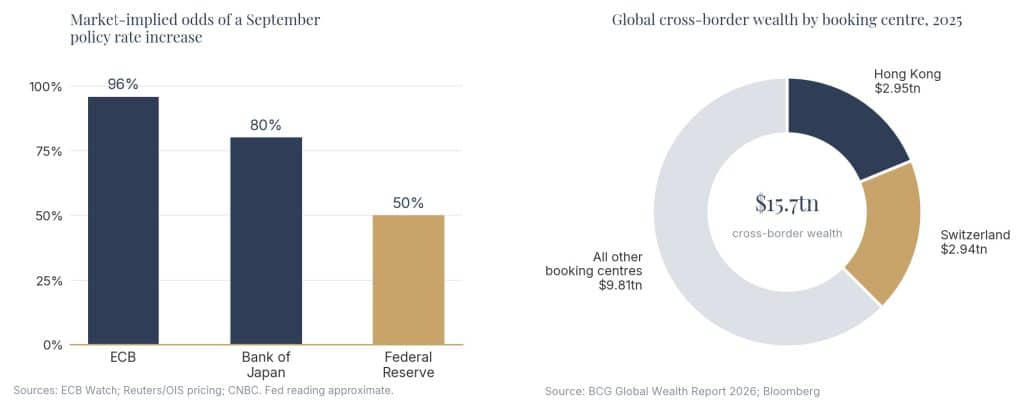
The defining feature of this cycle is that developed-market central banks are tightening, not easing. Under Chair Kevin Warsh the Federal Reserve has made clear that inflation, not employment, is the binding constraint; in his August remarks he described labour markets as “quite stable” and inflation as running too high. Swaps now price roughly even odds of a quarter-point US increase this month, down from about 70% earlier in the week after Waller’s more cautious tone. The ECB is close to fully priced for a 25bp move to 2.50% (eurozone HICP ran at 2.9% in July), and the Bank of Japan — which raised to 1.00% in June, its highest since 1995 — carries roughly 80% odds of a further increase.
Rates, currencies and commodities
The US curve remains historically steep at the long end: two-year notes firmed, the ten-year yield eased roughly three basis points to about 4.77% and the thirty-year sits at 5.24%. For clients holding cash, three-month bills still yield 3.77%. The dollar index has slipped to around 99. The yen is the notable mover, up more than 1% to 156.15 — its strongest since 3 August, shortly after the joint US–Japan intervention of 31 July.
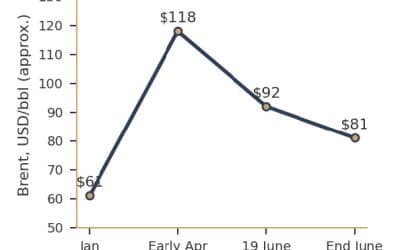
Commodities carry the geopolitical risk premium. Brent traded above $96 a barrel after Iran fired missiles at Kuwait, having gained more than 7% over the week as the United States and Iran exchanged strikes for the first time since July. Gold sits near record levels around $4,520 an ounce. Bitcoin rallied above $78,000.
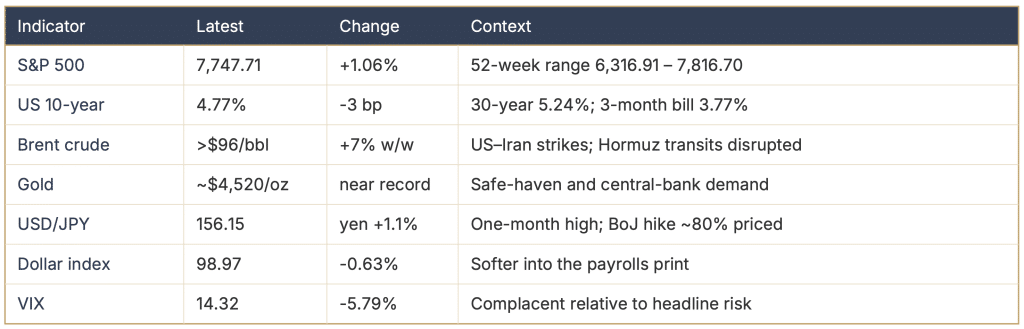
Sources: Yahoo Finance market data; CNBC; Reuters. Levels as at the most recent close and European morning trade, 4 September 2026.
Today’s release
The Bureau of Labor Statistics publishes the August employment situation at 08:30 ET (14:30 CET). Consensus is for roughly 50,000–58,000 jobs and an unemployment rate steady at 4.1%. The set-up is unusually soft: July payrolls fell 23,000 and May–June were revised down by a combined 103,000. This week’s partial indicators pointed the same way — ADP private payrolls rose only 38,000 against 47,000 expected, ISM services employment stayed in contraction at 47.8, and initial claims ticked up to 206,000. Set against that, Challenger recorded 53,000 announced layoffs, the slowest August since 2022. The description that fits is cooling, not cracking.
“Labor markets are quite stable” — Kevin Warsh, Chair, Federal Reserve, August 2026
The practical point for portfolios is that a weak print no longer mechanically implies easier policy. With the September decision hinging on the 11 September inflation release, today’s number is more likely to move the front end of the curve and the dollar than to settle the rate debate.
Sources: Bureau of Labor Statistics; CNBC; Yahoo Finance; Kiplinger; Benzinga.
WEALTH & PRIVATE BANKING
The structural story of 2026 remains the eastward drift of cross-border wealth. BCG’s Global Wealth Report 2026 confirmed that Hong Kong has overtaken Switzerland for the first time as the world’s largest cross-border booking centre, at roughly $2.95 trillion against $2.94 trillion, after a 10.7% rise driven by mainland Chinese inflows and a revived IPO market. Global financial wealth grew 10.7% in 2025 to $333 trillion; cross-border wealth rose 8.4% to $15.7 trillion, with the top ten booking centres capturing almost 90% of new offshore flows.
BCG’s framing is useful for client conversations: cross-border wealth is consolidating into two hub networks
— Hong Kong and Singapore serving mainland Chinese, Indian and Southeast Asian capital, and Switzerland, the United States and the United Kingdom serving European, Middle Eastern and Latin American wealth. The UAE remains among the fastest-growing centres, up 11.1%. The report also notes that as compliance costs rise and cross-border requirements tighten, many international managers are retreating towards the ultra-high-net-worth segment, leaving the $250,000-plus affluent tier structurally underserved.
Industry moves this week
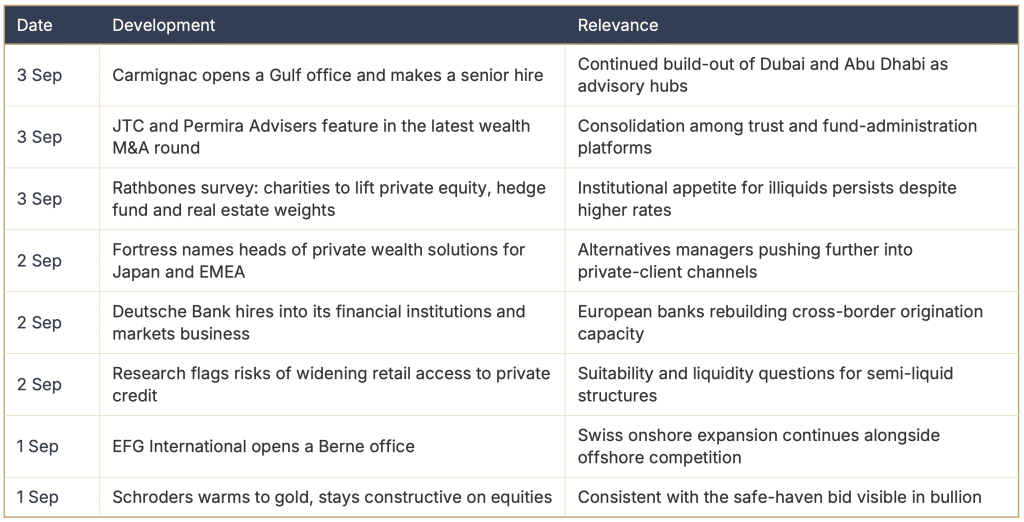
Source: WealthBriefing daily news, 1–3 September 2026.
Cross-border tax: the planning backdrop
No new measure landed today, but the direction of travel continues to shape client positioning. The UK non-domiciled regime was abolished on 6 April 2025 and replaced by the four-year foreign income and gains regime, available only to those non-resident for at least ten prior years. Italy’s flat-tax charge for new arrivals has risen to EUR 200,000. Against that, the Swiss lump-sum arrangement remains available in roughly nineteen of twenty-six cantons and has gained relative appeal. General net wealth taxes persist in Europe only in Switzerland, Spain and Norway, though several jurisdictions achieve comparable effects by other means. Under CRS and DAC reporting, the practical distinction between onshore and offshore visibility has all but disappeared — a point worth restating with clients considering a change of residence.
Sources: KPMG Switzerland; Chambers International Tax 2026; BCG Global Wealth Report 2026; Bloomberg.
WORLD NEWS
Middle East
The six-month US–Iran conflict escalated again this week. President Trump announced strikes on Iranian targets near the Strait of Hormuz, citing Iranian sea mines and missile attacks on a US base in Jordan; Iran fired missiles at Kuwait, with Kuwait, Jordan and Bahrain intercepting incoming fire. Vessel crossings through the strait fell from 23 the previous Wednesday to 10 on Monday, though the US Energy Secretary said more than 17 million barrels transited on Monday under military protection — a wartime record. The President indicated he does not expect a return to full-scale war. Oil is the transmission mechanism to portfolios, and it is the single largest swing factor in the inflation outlook.
Geopolitics
President Xi Jinping visited Egypt this week, his first trip there in a decade — read widely as China expanding its position while US attention and influence are absorbed by the Iran conflict. In Ukraine, Russian air attacks struck warehouse facilities in Kyiv on 2 September. In the Americas, former Venezuelan president Nicolás Maduro and his wife have asked a US judge to dismiss drug-trafficking charges on immunity grounds.
Politics and the calendar
US midterm elections in November are now a live market variable: the oil price spike and its effect on household costs have become a political problem for the governing party, which raises the probability of policy responses aimed at energy prices. For cross-border clients this argues for keeping currency and energy exposure deliberate rather than incidental.
Sources: CNBC; Al Jazeera; The National; NPR; US News & World Report.
Adviser view
Markets are pricing a benign outcome — equities at highs, volatility at 14 — while the underlying conditions are anything but settled: an active regional war setting the oil price, three major central banks weighing increases in the same month, and a labour market that has added almost nothing since May. That is not a reason to reposition today. It is a reason to be deliberate about duration, currency and liquidity before the 11 September inflation print, and to make sure clients understand that “higher for longer” now plausibly means “higher again”.
SOURCES
Markets and macro
Yahoo Finance market data and world indices, 3–4 September 2026 · CNBC, “Stock market news” and “August 2026 jobs report” · Bureau of Labor Statistics, Employment Situation · Kiplinger, Benzinga and Morningstar payrolls previews · FXStreet and CNBC on ECB and Bank of Japan pricing.
Wealth and private banking
BCG, Global Wealth Report 2026: The Great Reordering (27 May 2026) · Bloomberg, “Hong Kong Overtakes Switzerland as Top Offshore Wealth Hub” · WealthBriefing daily news, 1–3 September 2026 · KPMG Switzerland on the UK non-dom regime · Chambers, International Tax 2026 — Switzerland.
World news
CNBC, “Brent oil price above $96 after Iran fires missiles at Kuwait” · Al Jazeera, Strait of Hormuz coverage · The National, oil market report, 2 September 2026 · NPR and US News & World Report world headlines.
All figures and statements above are attributed to the third-party publications named. DTB Wealth Management is not the originating source of any market data or news item in this briefing.
Important information.
This briefing is prepared for information purposes only and is confidential to the recipient. It does not constitute investment, legal or tax advice, nor an offer or solicitation to buy or sell any financial instrument. All market data and news are attributed to the third-party sources named above; DTB Wealth Management is not the source of the underlying data and gives no warranty as to its accuracy or completeness. Market levels are indicative and were captured during European trading on 4 September 2026, before the release of the US August employment report. The value of investments can fall as well as rise and past performance is not a guide to future returns. Cross-border tax and residence positions should be confirmed with a qualified adviser in the relevant jurisdiction.